01
How Much Does a Pergola Motor Cost?
motor unitgear mechanism
Pergola motor pricing in Dubai varies primarily by torque rating and brand tier.
Entry-level tubular motor units start around AED 400–700 each and suit lighter, narrower blind panels up to roughly 3 metres wide. Mid-range radio-controlled units with a built-in gear mechanism for smooth deceleration typically fall between AED 800 and AED 1,800. For a complete single-bay villa terrace installation — one or two panels, track, motor unit, and wiring — installed prices generally begin around AED 1,500–2,500 per panel. Dubai-specific requirements push material costs above temperate-market equivalents: fabrics must be UV-stable and heat-rated for ambient temperatures that regularly exceed 45 °C between June and September, and standard sealants used in cooler climates delaminate under those conditions. Always confirm whether your quote itemises track, motor, and labour separately.
02
Can a Faulty Pergola Blind Be Repaired?
motor faulttrack jam
Most pergola blind faults can be diagnosed and resolved without replacing the entire system.
The two most common categories are motor fault — typically burned-out windings from thermal overload during Dubai's peak summer heat, or a failed limit switch — and track jam, where runners corrode or deform and prevent the blind from travelling its full stroke. A technician tests the electrical side first (motor, receiver, and control wiring) before inspecting the mechanical components. If the motor itself has failed, swapping the tubular motor unit is usually more cost-effective than rewinding, and most standard motors can be changed without dismounting the full blind assembly. Diagnostic and minor-repair visits typically start around AED 250–400. If the motor unit needs replacing, expect AED 600–1,200 depending on the replacement motor's torque and brand. Corrosion in track runners — accelerated by Dubai's humidity spikes above 90 percent — is assessed and quoted separately.
03
Where Can You Get Motorised Blinds Installed in Dubai?
villa installationDubai coverage
Emirates Pergola & Glass Works carries out motorized blinds in Dubai installations across all major residential zones, including villa installation projects in Jumeirah, Arabian Ranches, Mirdif, Al Barsha, Dubai Hills, The Springs, The Meadows, and Palm Jumeirah. Dubai coverage extends to new villa compounds and townhouse clusters built between 2000 and 2015, where flat-roofed terraces and rear garden pergolas are the most common installation sites. We also serve commercial outdoor dining areas and hotel pool decks. Lead times from survey to installation are typically 5–10 working days for standard single-bay systems. Where the pergola structure itself is a new addition requiring a Dubai Municipality No Objection Certificate and building permit, we coordinate permit documentation before fabrication begins, which extends the overall timeline but keeps the project fully compliant.
04
Motorised vs Manual Blinds: Which Suits Dubai Villas?
wind sensorremote control
For year-round outdoor use in Dubai, motorised systems hold a clear practical advantage over manual ones.
The most important difference is wind-sensor compatibility: a motorised blind paired with a wind sensor retracts automatically when gusts exceed a preset threshold, which matters significantly during Shamal events between May and July when silica-laden winds arrive with little warning. A manual blind requires someone on site to physically pull it closed — impractical overnight or when a property is empty. Motorised systems also allow precise position control via remote control or a connected app, letting residents adjust shading without stepping into 45 °C heat. The trade-off is higher upfront cost and a maintenance obligation for the motor. For occasional or supervised use, manual blinds remain viable, but for a villa where the terrace is used regularly and unattended for periods, the automation case is strong.
05
What Does Installation Involve?
bracket mountingwiring
A motorised pergola blind installation follows four sequential stages.
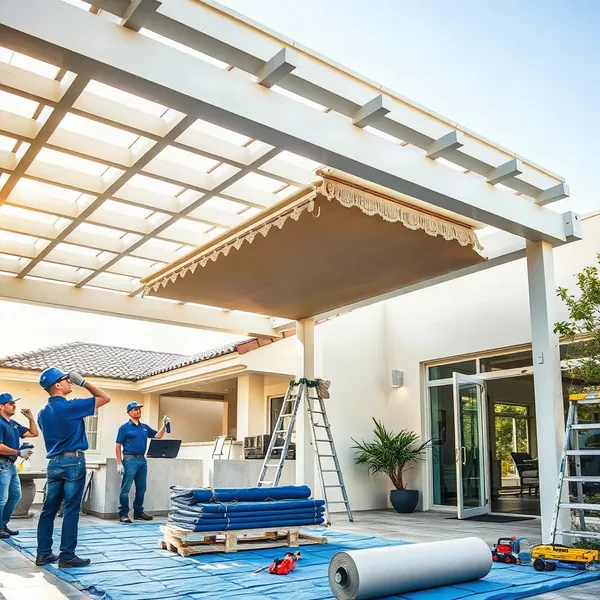
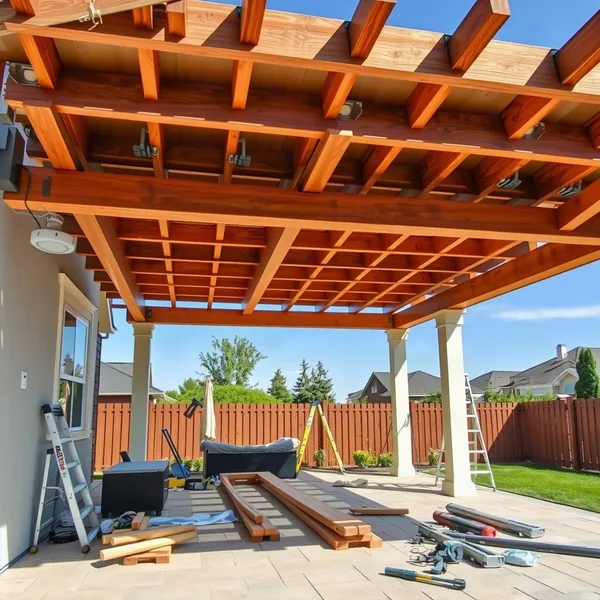
First, bracket mounting: stainless-steel side tracks and end brackets are fixed to the pergola's aluminium or steel frame, set level, and load-tested. The blind cassette — housing the rolled fabric or aluminium slats — is then hung and aligned to the track. Second, the motor unit is connected to a dedicated 220V circuit; wiring is run through the pergola frame profile where possible to keep cable routes clean and protected from the sun. Third, the motor's open and closed travel limits are programmed precisely so the blind stops without over-running or stressing the fabric. Finally, the remote control receiver, and any wind sensor or smart home integration module, is paired and tested through a full operating cycle. A single-bay installation typically takes 3–6 hours on site.