01
What Is a Non-Thermal-Break Hinged Door?
aluminium profilesingle hinge setglazing panel
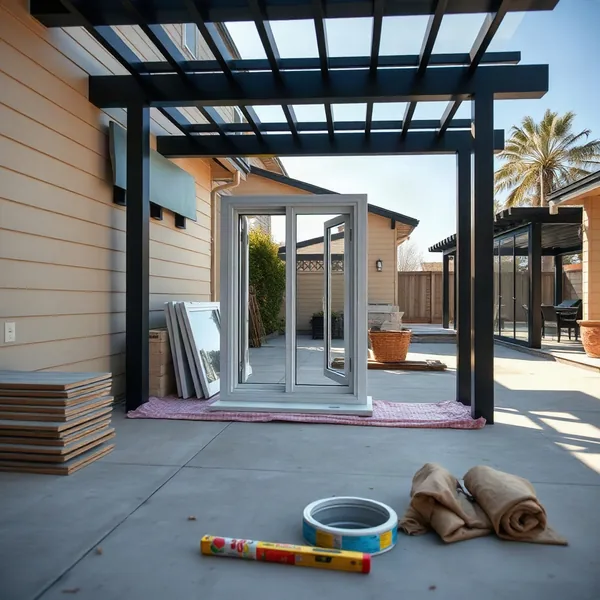
A non-thermal-break hinged door is an aluminium profile frame with no polyamide insulating strip separating its inner and outer sections, hung on a single hinge set and fitted with a glazing panel of clear, frosted, or tinted glass.
Because the aluminium runs continuously through the frame cross-section, it conducts temperature directly from one face to the other without interruption. Standard single-leaf configurations span roughly 700 mm to 1,000 mm wide and up to 2,400 mm tall. This door type is simpler to fabricate than its thermal-break counterpart, which makes it faster to produce and less expensive — typically 20 to 35 percent cheaper for the same frame size and glass specification.
02
How Much Does Installation Cost in Dubai?
door hardwareframe sizelabour
A standard single-leaf non-thermal-break hinged door costs from AED 800 to AED 1,500 fully installed, covering frame fabrication, a 6 mm or 8 mm tempered glazing panel, basic door hardware, and labour.
Double-leaf configurations run AED 1,800 to AED 3,500 depending on overall frame size and glass choice. The three biggest cost drivers are door dimensions, hardware grade — standard butt hinges sit at the lower end while heavy-duty pivot sets or floor closers add AED 200 to AED 600 — and glass specification. Upgrading to 10 mm or 12 mm tempered glass for a pergola or gazebo access point pushes quotes toward the upper range. Powder-coat colour changes to the aluminium frame typically add AED 150 to AED 400 per door.
03
Does It Let in More Heat During Dubai's Summer?
thermal conductivitysolar heat gainAC load
Yes, noticeably. Aluminium has a thermal conductivity of approximately 160 W/m·K, and a non-thermal-break frame transmits that heat straight through.
Between June and September, when Dubai's ambient temperatures regularly exceed 45 °C according to the UAE National Centre of Meteorology, an exposed aluminium frame face can reach surface temperatures well above that — meaning the room-side face of the profile gets genuinely hot. For any air-conditioned room, this raises AC load and DEWA electricity consumption. The glazing panel is actually the dominant heat path, so specifying a low-e or reflective-coated glass reduces solar heat gain considerably. That said, for a properly cooled entrance, a thermal-break profile is the technically correct choice. Non-thermal-break doors suit pergola enclosures and semi-open spaces where AC penalty is irrelevant.
04
How Long Does Installation Take?
door frame fittingsealant curehinge alignment
A single-leaf door into a prepared, square opening takes 2 to 4 hours from start to finished sealant application, covering door frame fitting, glazing, hardware, and hinge alignment.
A double-leaf door in a ready opening typically takes 4 to 6 hours. If the structural opening needs cutting or widening — common in Dubai villa compounds built between 2000 and 2015, where block walls or lightweight steel partitions sometimes require adjustment — budget an extra 1 to 2 working days for opening preparation before door fixing can begin. Sealant cure time is normally 24 hours before the door should be used under regular load. For pergola or gazebo projects where the surrounding frame is being built on the same visit, door installation is coordinated into that single trade day.
05
Is It Suitable for Main Villa Entrances?
high-traffic doorthermal-break alternativesecurity hardware
A non-thermal-break door can physically occupy a main villa entrance, but it's not the recommended specification for that application in Dubai.
A high-traffic door at a villa front separates a 45 °C exterior from an air-conditioned interior, and the continuous aluminium frame becomes a direct conduction bridge — raising cooling loads and increasing DEWA consumption. During the high-humidity summer nights that the UAE National Centre of Meteorology records, interior condensation on the frame is also a real risk. The thermal-break alternative, which interposes a low-conductivity polyamide strip through the frame, is the standard for villa front doors and any conditioned-to-unconditioned threshold. Non-thermal-break doors are best paired with heavier security hardware in utility-side roles rather than primary living-space entrances.
06
Which Dubai Properties Suit This Door Type?
storage roomsservice entrancesnon-AC areas
Non-thermal-break hinged doors are well-suited to service entrances, storage rooms, pool equipment rooms, covered parking access points, and any non-AC area on a Dubai residential or commercial property.
Pergola enclosures and gazebo glazed walls are a particularly common application — these structures are semi-open by design, so the frame's conductivity carries no meaningful energy penalty. Older villa compounds across Dubai, many built between 2000 and 2015, frequently have detached utility buildings or boundary-wall gate openings where a straightforward aluminium-framed hinged door is the practical, proportionate solution. Because Dubai Municipality NOC requirements still apply to structural additions, we confirm permit status during the initial site survey before fabrication begins, keeping the project timeline predictable. Double glazing is occasionally specified in these spaces for acoustic separation rather than thermal performance.